How to Choose Scheduled Task Automation Software: A Buyer's Guide
You need reminders to fire on time, approvals to route correctly, and reports to arrive without someone chasing them. Yet most task software still asks your team to log into yet another dashboard they will ignore by week two.
This guide walks through what to check before you buy scheduled task automation: must-have capabilities, onboarding friction, field team features like attendance and GPS tracking, security, and pricing. It also shows where Tasks.Bot fits that checklist, so you can decide with clear criteria.
What Is Tasks.Bot?
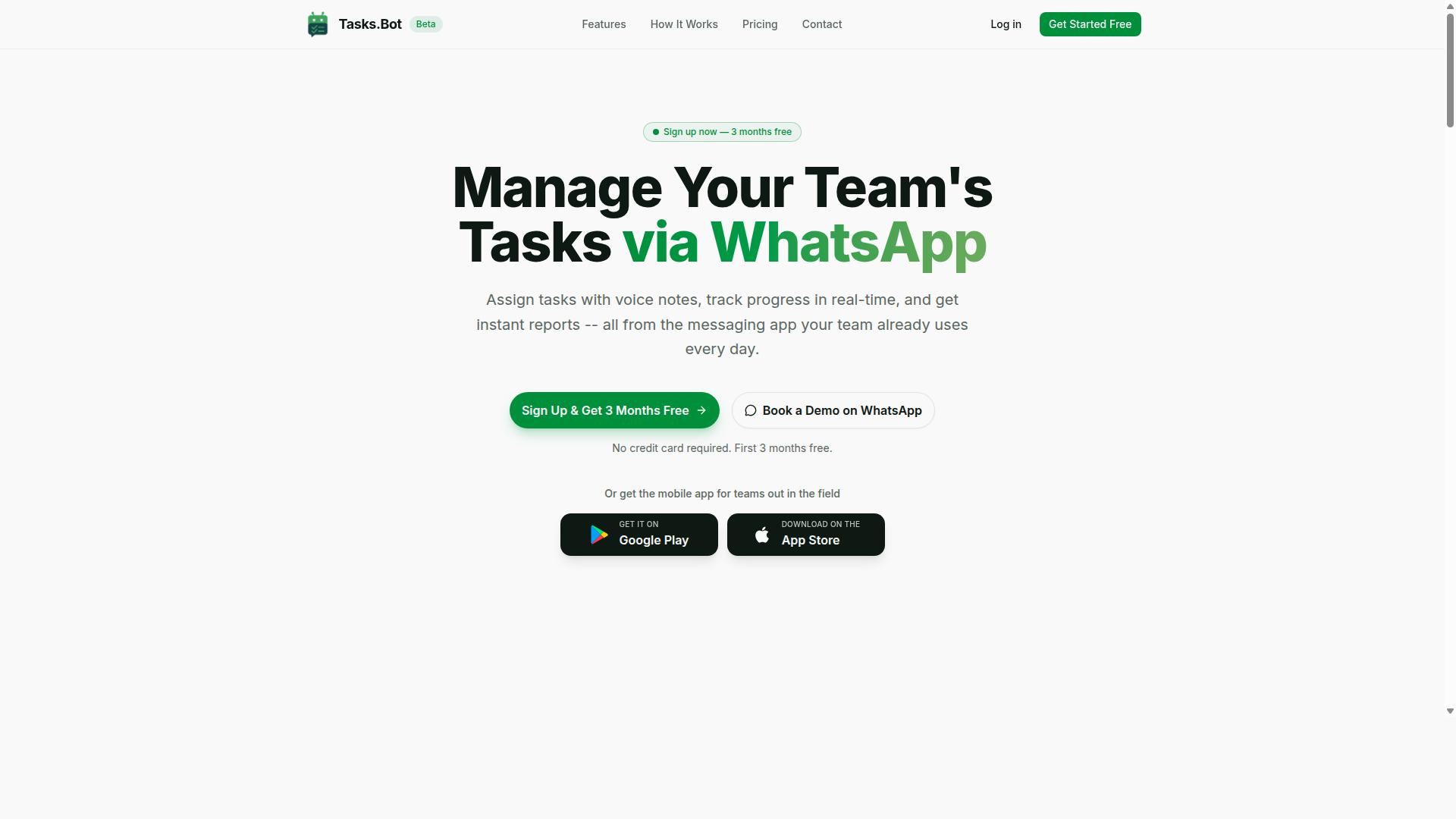
Tasks.Bot is a task management platform that operates entirely within WhatsApp, enabling teams to assign tasks, track progress, and receive reports without leaving the messaging app. It is a WhatsApp-native task automation tool, which means the messaging app your team already uses every day becomes the place where work actually gets managed.
Its core function covers three areas: task assignment, progress tracking, and reporting. A manager creates a task, the right person receives it, and updates flow back through the same conversation thread. There is no separate tool to check and no status meeting required to find out where things stand.
For teams that work outside an office, Tasks.Bot also offers a mobile app for field teams. The platform includes face-verified attendance and live GPS tracking for field staff, capabilities that matter when you need to confirm who was where, and when.
Within the scheduled task automation software category, Tasks.Bot stands apart from traditional tools that require separate logins or installations. Team members do not need to install anything or create new accounts. That single design choice removes the biggest barrier to adoption: getting everyone onto yet another platform.
The service is currently in beta and offers a free trial period, with a three-month free trial that requires no credit card. Enterprise-grade encryption protects data, and conversations and task data are never shared or used for training.
How Tasks.Bot Fits the Scheduled Task Automation Buyer's Checklist
When evaluating scheduled task automation software, buyers typically look for capabilities like trigger-based execution, dependency management, and reporting. Tasks.Bot addresses these through a conversational interface, which changes how the checklist gets satisfied rather than which items apply.
Start with task creation. Tasks.Bot uses AI to understand natural language and voice notes, so a task can be described the way you would explain it to a colleague. This lowers the skill floor considerably compared with tools that expect a command-line interface, a PowerShell or Bash script, or a carefully configured job scheduler.
Next, consider automation triggers. Buyers comparing a cron replacement or a workflow automation platform usually weigh two models: time-based scheduling and event-driven automation. Tasks.Bot handles both patterns inside WhatsApp, so a recurring reminder and a task that follows from a specific event can live in the same conversational space your team already monitors.
Reporting is the third common criterion. Instead of logging into a web-based dashboard to pull status, managers receive instant reports through the messaging app. Approvals follow the same path, keeping sign-off inside the thread where the work was assigned.
Finally, weigh deployment overhead. Agent-based architectures and configuration management requirements add setup cost that a buyer's guide should account for. Tasks.Bot sidesteps this entirely: no new accounts, no installations, no separate app for most users. For teams weighing a full DevOps toolchain against lighter options, that is a meaningful difference in total effort.
Must-Have Capabilities in Scheduled Task Automation Software
Effective scheduled task automation software must handle task creation, assignment, deadline tracking, approvals, and reporting, often across distributed teams and systems. When any one of these capabilities is missing, work slips through the cracks and managers fall back on manual follow-up.
The stakes rise sharply for teams with field staff. A crew spread across job sites cannot walk over to a desk to confirm a task was received or ask about status in person. The software has to carry that coordination load instead.
Buyers should evaluate each capability against a simple test: does it remove a manual step, or does it just digitize one? A tool that stores tasks but still requires a manager to assign every job by hand has not automated much.
These core capabilities also connect to one another. Assignment depends on clean task creation. Reminders depend on accurate deadlines. Reporting depends on reliable status data flowing from the field. Weakness in one area undermines the rest, which is why the buyer's guide checklist should treat them as a connected set rather than isolated features.
Tasks.Bot approaches this set through native WhatsApp integration, letting teams create and manage tasks where they already communicate. It pairs voice note task creation with automatic task assignment, smart deadline reminders, approvals and automations, and instant reports.
Task Creation, Assignment, and Smart Deadline Reminders
In any task automation tool, the ability to quickly create tasks, assign them to the right people, and set smart deadline reminders is fundamental to keeping work on track. Speed of creation matters most, because friction at this step discourages the team from logging work at all.
Modern tools reduce that friction in two main ways. Natural language processing lets a user type a task the way they would say it, and the system interprets the intent. Voice notes go a step further for anyone working with their hands, such as a technician on a ladder or a driver between stops.
Tasks.Bot uses AI to understand user intent and create tasks from messages, and it supports voice note task creation directly inside WhatsApp. That means the tool meets field staff in an app they already use daily, rather than asking them to learn a new interface.
Assignment is the next link in the chain. Automatic task assignment routes work to the right person without a manager manually sorting every item, which matters when jobs arrive throughout the day.
Smart deadline reminders then keep those assignments honest. Instead of a single static alert, effective systems tie reminders to triggers and dependencies, so a follow-up fires when a prerequisite is done, when a due date approaches, or when a task sits untouched too long.
Together these features cut the manual follow-up that eats a supervisor's day. Consider a field service team with ten jobs in progress. Without automation, someone must confirm each assignment, track each deadline, and chase each update. With it, the system handles the routine nudges and escalates only what needs human attention. The result is fewer dropped jobs and more time for actual supervision.
Approvals, Automations, and Instant Reporting
Approval workflows and instant reporting are critical for maintaining quality control and visibility in automated task management systems. Without them, automation speeds up the work but leaves managers blind to whether it was done correctly.
Manual approvals create bottlenecks. A request sits in an inbox until someone remembers to review it. Automating the approval step, with clear routing and status tracking, keeps decisions moving and creates a record of who approved what and when.
That record carries real value for compliance. Industries that require sign-off on completed work, from equipment checks to safety inspections, benefit from approvals that are captured inside the same system that created the task. Nothing depends on a paper trail that can be lost.
Instant reporting closes the loop. Real-time insight into task status and team performance lets managers spot problems while there is still time to fix them, rather than discovering them in a month-end review.
Tasks.Bot bundles approvals and automations with instant reports, so approval decisions and task status feed directly into the reporting view. Teams also get tasks on a map and a live day tracker, which give field operations a visual sense of where work stands right now.
For continuous improvement, this data matters as much as the daily oversight. Patterns in completion rates, approval delays, and recurring blockers point to process fixes. A team that reviews its own reports can adjust assignments, deadlines, and workflows over time instead of repeating the same problems.
For buyers, the takeaway is to test these capabilities against real scenarios. Ask how a task gets created in the field, how it reaches the right person, how a reminder fires, who approves the result, and where that result shows up in reporting. A tool that answers all five clearly is built for accountability, not just for storing a to-do list.
Evaluating Ease of Adoption for Your Team
Adoption friction is a major factor in the success of any task automation software, influencing training time, user compliance, and overall return on investment.
A tool can have every feature on your checklist and still fail if your team never opens it. That is why ease of adoption deserves the same weight as functionality when comparing scheduled task automation software. Buyers who skip this step often discover the real cost later, in abandoned licenses, shadow workflows, and manual workarounds that quietly replace the tool.
Three factors tend to predict whether adoption succeeds or stalls:
- User interface: A graphical user interface or web-based dashboard lowers the barrier for non-technical staff, while a command-line interface suits engineers comfortable with script execution in PowerShell, Bash, or Python.
- Learning curve: Time-based scheduling, trigger-based execution, and dependency management all take practice. Simple visual builders shorten that path; complex job orchestration logic extends it.
- Integration with existing tools: Software that plugs into platforms your team already uses daily reduces the number of new habits required, which speeds up deployment across departments.
Adoption also shapes how far automation spreads. A scheduler that fits your DevOps toolchain may satisfy engineers but leave operations or field staff behind. A tool that lives inside a familiar messaging platform reaches both groups. For buyers weighing workflow automation, runbook automation, or IT process automation, the practical question is not which product has the longest feature list, but which one your people will actually use after week one.
Why WhatsApp-Native Automation Removes Onboarding Friction
By leveraging WhatsApp, a platform already used by billions, Tasks.Bot eliminates the need for new installations, account creation, or extensive training.
This is the core of the Tasks.Bot approach. The software operates entirely within WhatsApp, so team members do not need to install anything or create new accounts. Instead of learning a new web-based dashboard or command-line interface, they interact through a chat interface they already know. Tasks.Bot uses AI to understand natural language and voice notes for task creation, which means a worker can describe a job in plain words rather than navigate menus or memorize syntax.
The effect on onboarding time is direct. There is no download step, no password to manage, and no separate app to remember. A field team, for example, can be given a task in a WhatsApp message and respond in the same thread, with no setup session required. Adoption happens in minutes rather than days because the tool meets people where they already are.
For managers evaluating scheduled task automation software, this matters beyond convenience. Tasks.Bot also offers face-verified attendance and live GPS tracking for field staff, capabilities that only deliver value if staff actually use the system. Enterprise-grade encryption protects the data, and conversations and task data are never shared or used for training. A 3-month free trial with no credit card required lets a team confirm the adoption story for itself before committing. When the interface is already familiar, resistance drops and deployment accelerates, which is precisely how Tasks.Bot turns ease of adoption into a measurable advantage.
Field Team Features: Attendance, GPS Tracking, and Hours
For teams with field staff, task automation software must go beyond basic scheduling to include attendance tracking, GPS location verification, and payroll-ready hour logging. These three capabilities turn a simple job scheduler into a system that answers the questions managers actually ask every day: did the worker show up, were they at the right site, and how many hours should payroll process?
Without them, field operations rely on paper timesheets, phone calls, and guesswork. That gap creates disputes over hours, delays in payroll, and no reliable record of who was where. A buyer evaluating scheduled task automation software should treat field team features as a separate checklist, not an afterthought.
This matters most in construction, logistics, and field services, where crews are mobile and rarely sit at a desk. Tasks.Bot serves teams that already run their operations through WhatsApp, including those with field staff who need task management, attendance tracking, and payroll-ready hours.
Face-verified attendance confirms that the person clocking in is the person assigned to the job. Instead of a shared PIN or a buddy punching a colleague in, the check-in is tied to a verified identity. For a buyer, the question to ask vendors is simple: what stops one worker from clocking in for another?
GPS location verification records where a check-in or task completion happened. That gives dispatchers and supervisors a factual record for site validation, route confirmation, and client disputes. It also supports accountability without constant manual check-ins.
Automatic hour calculation converts attendance and task events into payroll-ready totals. When hours flow from the same system that assigns the work, there is no separate spreadsheet to reconcile. Buyers should confirm how the software handles breaks, overtime rules, and export formats before committing.
The real value appears when these features connect to task assignment and reporting. A dispatcher assigns a job, the worker checks in at the site, the task is marked complete, and the hours are logged against that job. Reporting then shows completion rates, time on site, and labor cost per task in one place.
When evaluating options, ask vendors these questions:
- Does attendance use face verification, and can it work on the devices your crew already carries?
- Is GPS captured at check-in only, or throughout the task?
- Are hours calculated automatically, and can they be exported for payroll?
- Do attendance and location data attach to the same task records used for reporting?
- Does the system fit the messaging tools your team already uses daily?
For teams already coordinating on WhatsApp, this integration matters. Tasks.Bot is built for that audience, and the site notes that hundreds of teams already use the service. That context is worth weighing if your field staff live in chat apps rather than desktop dashboards.
Construction crews, delivery drivers, and on-site service technicians all benefit from the same pattern: verified attendance, location proof, and clean hour totals feeding directly into task reporting. A buyer who checks these boxes avoids the most common failure point in field automation, which is a scheduling tool that cannot tell you who actually did the work.
Security, Reliability, and Data Protection
Security and reliability are non-negotiable in task automation software, especially when handling sensitive team data and mission-critical workflows. A missed job or a leaked credential can stall operations, so it pays to evaluate how a tool protects your information before you commit.
As you compare options, treat these areas as your core checklist:
- Data encryption in transit and at rest, so task details and credentials stay unreadable if intercepted or stored improperly
- Access controls such as role-based permissions and audit logs, which limit who can create, edit, or trigger jobs
- Regulatory compliance including GDPR and similar data protection rules, particularly if your team or customers are in regulated regions
- Uptime guarantees expressed as a service level agreement, so you know what reliability the vendor commits to
- Vendor transparency around incident handling, backups, and recovery, which signals how seriously the provider treats downtime
For non-technical buyers, the practical question is simple: does the vendor explain its safeguards in plain language? If a provider cannot describe how it stores your data or who can access it, that is a warning sign regardless of how polished the dashboard looks.
Tasks.Bot approaches these concerns through its WhatsApp integration and mobile app, letting teams manage scheduled work through channels they already trust. The site also includes a Book a Demo on WhatsApp option, which gives prospective buyers a direct way to ask security and reliability questions before adopting the tool.
Reliability signals matter too. Tasks.Bot mentions a refund policy in its footer, a detail that suggests the vendor stands behind its service and gives buyers a fallback if expectations are not met. The service is currently in beta, so it is worth confirming current safeguards and any planned certifications directly with the team during evaluation.
Before signing up for any scheduled task automation software, ask vendors to clarify encryption standards, access control options, compliance posture, and uptime commitments in writing. That diligence protects your workflows and confirms whether a platform like Tasks.Bot fits your risk tolerance.
Pricing and Plans: What to Compare Before You Buy
When comparing pricing for scheduled task automation software, consider factors like per-user costs, feature tiers, contract flexibility, and hidden fees. These four levers decide whether a tool stays affordable as your automation footprint grows or quietly becomes one of your largest software line items.
Per-member versus flat-rate billing is the first fork in the road. Per-member pricing scales with headcount, which suits small teams but punishes growth. Flat-rate plans are predictable, yet they often cap the number of users, jobs, or connected systems. Map your expected team size over the next year before picking a side.
Next, look at how features are gated. Many vendors split capabilities across tiers, so advanced scheduling, dependency management, or longer execution logs sit behind a higher price. Ask one blunt question: does the entry tier actually cover your use case, or will you need an upgrade within months?
Contract terms matter just as much as the sticker price. Check for:
- Monthly versus annual billing, and the real size of any annual discount
- Overage charges for extra runs, members, or storage
- Onboarding, support, or implementation fees buried in the fine print
- Cancellation terms and whether unused time is refunded
Finally, insist on a trial. A free trial or demo period lets you test trigger-based execution and time-based scheduling against your own workloads before money changes hands. Align cost with team size and required capabilities, not with a feature list you may never use.
Tasks.Bot's Full Access Plan and Free Trial
Tasks.Bot offers a single 'Full Access' plan that includes all features, with pricing at ₹200 per member per month or ₹1,200 per year per member, and a free trial for new users. There are no tiers to decode and no feature gates to work around. Every capability sits in the same plan for every team size.
That structure removes the most common buyer's-guide headache: guessing which tier you actually need. A small team running a handful of time-based scheduling jobs and a larger group coordinating job orchestration get the same feature set at the same per-member rate.
Pricing is listed in Indian Rupees and US Dollars, and the site shows a 'Select currency' option for both, so verify the currency before you commit. The annual plan works out to ₹1,200 per year per member, a saving of 50% compared with paying monthly, or ₹1,200 saved per member each year.
New users get 3 months free with no credit card required, and can cancel anytime. Starting a trial is simple: reach out on WhatsApp to begin. The same channel handles questions about the plan and scheduling a walkthrough. If you want to see how the Full Access plan fits your workflow, book a demo on WhatsApp.
Who Should Use Tasks.Bot
Tasks.Bot is designed for teams that rely on WhatsApp for communication, particularly those with field staff needing task management, attendance tracking, and payroll-ready hours. If your daily coordination already happens in chat threads, this tool fits the way your crew already works rather than forcing a new habit.
The ideal fit is a small to medium-sized team with people spread across job sites, vehicles, or client locations. Construction crews, logistics operations, field service technicians, and any mobile workforce fall squarely into this group. Their common problem is simple: office software assumes a desk, and field staff rarely sit at one.
Tasks.Bot solves that mismatch by working through the messaging app your team already has open. There is no new app to download or learn, which removes the biggest hurdle in adopting any scheduled task automation software: getting everyone to actually use it.
Adoption matters more than features in field settings. A tool that field staff ignore delivers zero value, no matter how capable it is. Because Tasks.Bot lives inside WhatsApp, the learning curve stays close to zero, and supervisors spend less time chasing compliance and more time running the job.
Beyond basic task assignment, the platform brings together the pieces a mobile team needs in one place. These include:
- Task management for assigning and tracking work across sites
- Attendance tracking so shift presence is recorded as it happens
- Payroll-ready hours that feed directly into pay processing
For a small construction firm, that could mean dispatching daily job assignments to crews on site and capturing their hours without paper timesheets. A logistics team might use it to coordinate drivers and confirm deliveries. A field services business could track technician visits and attendance in the same thread where work is discussed.
It is worth noting that Tasks.Bot is currently in beta and used by hundreds of teams globally. That stage signals active development and a product shaped by real feedback from working teams, not a finished, frozen release.
If your operation runs on WhatsApp and your people are rarely at a desk, Tasks.Bot is built for exactly that setup. Teams that need traditional desktop-first scheduling tools may look elsewhere, but mobile-first crews will find the fit natural.
Final Verdict
Tasks.Bot stands out as a practical, low-friction solution for teams seeking scheduled task automation within WhatsApp, especially those with field operations. Rather than asking staff to adopt yet another dashboard or command-line interface, it works inside the messaging app they already open every day.
For a buyer weighing scheduled task automation software, that familiarity matters. Adoption is often the hardest part of any rollout, and a WhatsApp-native tool sidesteps much of that resistance.
Here is where Tasks.Bot earns its place in your shortlist:
- WhatsApp-native operation: tasks and updates live in a channel your team already uses
- AI-powered task creation: setting up scheduled work takes less manual configuration
- Field team features: built with mobile, on-the-go workers in mind
- Transparent pricing: costs are clear upfront, which helps during budget comparison
No tool is perfect, and honest buyers should note that Tasks.Bot is still in beta status. That means the product is evolving, and teams with highly rigid compliance or reporting requirements may want to confirm current capabilities before committing.
For organizations already running on WhatsApp, however, that trade-off is usually minor. The fit between tool and workflow is simply tighter than with a generic task scheduler bolted onto separate systems.
If your team coordinates field staff, handles recurring jobs, or relies on time-based scheduling and reminders through chat, Tasks.Bot is a strong recommendation. It reduces tool sprawl and keeps everyone on one familiar platform.
If your operation is desk-bound and already standardized on a full workflow automation stack, evaluate whether a WhatsApp-first approach adds value or duplication before you switch.
Ready to explore it? Reach the team by phone at +91 97143 42522 or email [email protected]. You can also book a demo on WhatsApp to see how scheduled task automation would work for your team.
Frequently Asked Questions
Do my team members need to install new software or create accounts to use Tasks.Bot?
No. Tasks.Bot operates entirely within WhatsApp, so your team can assign tasks, track progress, and receive reports without installing anything or creating new accounts. There's also a mobile app available for field teams who need it. This makes onboarding fast for teams already communicating on WhatsApp.
How does Tasks.Bot handle task creation and deadlines?
Tasks.Bot uses AI to understand natural language and voice notes, so you can create tasks simply by typing or speaking in WhatsApp. It also supports automatic task assignment and smart deadline reminders to keep work on track. Approvals and automations are included as well, along with instant reports.
What does Tasks.Bot cost, and is there a free tier?
Tasks.Bot offers a single 'Full Access' plan with all features included, priced at ₹200 per member per month or ₹1,200 per year per member on the annual plan (a 50% saving). Pricing is available in Indian Rupees and US Dollars. For the latest details, including any refund terms, it's best to check directly with the Tasks.Bot team.
Is Tasks.Bot suitable for teams with field staff?
Yes. Tasks.Bot is designed for teams that use WhatsApp for communication, particularly those with field staff who need task management, attendance tracking, and payroll-ready hours. Features like face-verified attendance, tasks on a map, and live day tracking are built for exactly this kind of work. Hundreds of teams are already using the service.
Can I try Tasks.Bot before committing, and how do I get started?
Tasks.Bot offers a 'Book a Demo on WhatsApp' option, so you can see how it works before deciding. The service is currently in beta, and since it's a SaaS product accessible via WhatsApp and mobile apps, it's available worldwide with no country restrictions. You can reach the team at [email protected] or +91 97143 42522 with questions.
How should I compare automation tools when choosing one for my team?
Start by mapping where your team already communicates and works-if that's WhatsApp, a tool that lives inside it removes friction and adoption barriers. Then check whether the features you actually need (task assignment, reminders, approvals, reporting, attendance) are included rather than sold as add-ons. Finally, confirm pricing is transparent per member and that the vendor offers a way to demo or trial the product before you commit.
Recommended Resources: